
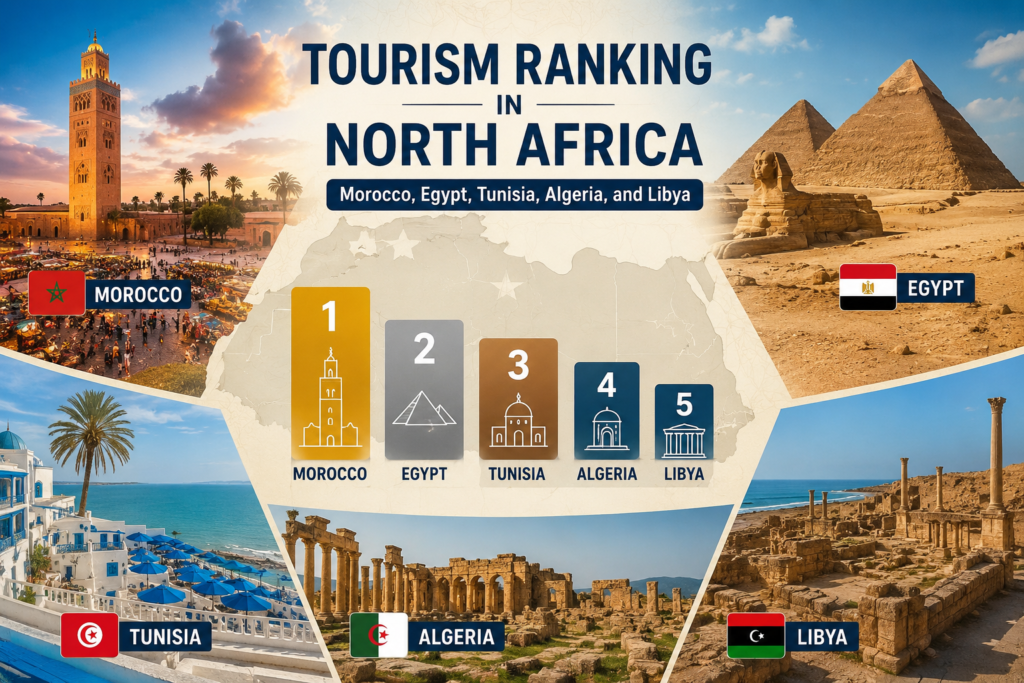
North Africa is one of the most attractive tourism regions in Africa. It offers a remarkable combination of ancient history, beautiful beaches, vast deserts, mountains, traditional cities, and diverse cultures. Among the main countries in the region, Morocco, Egypt, Tunisia, Algeria, and Libya stand out for their different tourism potential.
Based on the current strength of the tourism sector, international arrivals, infrastructure, diversity of attractions, and global tourism reputation, the five countries can be roughly ranked as follows.
1. Morocco
Morocco currently ranks among the strongest tourism destinations in North Africa. In 2025, the country welcomed approximately 19.8 million tourists, setting a new record.
Morocco has a highly diverse tourism industry. Visitors can explore historic cities such as Marrakech, Fez, Meknes, and Rabat, relax on the Atlantic and Mediterranean coasts, or discover the Atlas Mountains and the Sahara Desert.
The country also benefits from a well-developed hotel industry, international airports, improved transportation, and strong international tourism promotion. Marrakech, Agadir, Casablanca, Tangier, and the desert regions are particularly popular with international visitors
2. Egypt
Egypt is another major tourism power in North Africa and one of the most famous tourist destinations in the world. In 2025, Egypt received around 19 million international tourists.
The country’s greatest advantage is its extraordinary historical heritage. The Pyramids of Giza, the temples of Luxor and Aswan, and the Nile River attract millions of visitors every year.
Egypt also has an important beach tourism industry, particularly along the Red Sea. Destinations such as Sharm El-Sheikh and Hurghada are well known for their beaches, resorts, diving, and marine life.
Because of its ancient civilization, beaches, religious sites, and large tourism infrastructure, Egypt remains one of Africa’s leading tourism destinations.
3. Tunisia
Tunisia ranks third among the five countries. In 2025, the country welcomed more than 11 million tourists, reaching a new tourism record.
Tunisia is particularly famous for its Mediterranean beaches and resorts. Popular destinations include Hammamet, Sousse, Monastir, Djerba, and Mahdia.
However, Tunisia offers more than beach tourism. Visitors can also discover ancient Roman sites such as El Jem and Carthage, traditional medinas, and the country’s southern desert landscapes.
Its geographical proximity to Europe, competitive prices, and established hotel infrastructure make Tunisia an important destination for European and regional tourists.
4. Algeria
Algeria has enormous tourism potential, although its international tourism sector is currently less developed than those of Morocco, Egypt, and Tunisia.
The country has a very diverse geography, including a long Mediterranean coastline, mountains, historic cities, and one of the largest desert regions in the world.
The Algerian Sahara is particularly attractive for adventure and cultural tourism. Places such as Djanet, Tamanrasset, Timimoun, and Ghardaïa offer spectacular landscapes and unique cultural experiences.
Algeria also possesses important historical attractions, including Roman ruins, Islamic architecture, traditional towns, and cultural sites in cities such as Constantine, Tlemcen, Oran, and Algiers.
With greater investment in tourism infrastructure, international promotion, hotels, transportation, and tourism services, Algeria could significantly increase its position in the North African tourism market.
5. Libya
Libya currently ranks fifth among these five countries in terms of international tourism development. Nevertheless, the country has considerable tourism potential.
Libya has a long Mediterranean coastline, vast desert landscapes, and some of the most impressive ancient archaeological sites in North Africa. The ancient cities of Leptis Magna and Sabratha, for example, are important historical attractions.
However, political instability, security concerns, limited tourism infrastructure, and weak international tourism promotion have significantly affected the development of the sector.
If conditions continue to improve, Libya could develop important coastal, desert, cultural, and archaeological tourism industries.
Overall Ranking
A general ranking based on the current strength and international development of the tourism sector would be:
• 🇲🇦 Morocco
• 🇪🇬 Egypt
• 🇹🇳 Tunisia
• 🇩🇿 Algeria
• 🇱🇾 Libya
This ranking should be considered an overall tourism ranking rather than an official classification. The order could change depending on the criteria used, such as tourist arrivals, tourism revenue, infrastructure, natural attractions, historical heritage, or future potential.
Conclusion
North Africa has enormous tourism potential and offers a unique combination of history, culture, nature, and beaches. Morocco and Egypt currently lead the region, thanks to their large numbers of international visitors, strong tourism infrastructure, and global reputation. Tunisia follows closely with its well-established beach and cultural tourism industry.
Algeria and Libya, meanwhile, have enormous untapped potential. Algeria’s vast Sahara, Mediterranean coastline, and historical heritage could make it a major tourism destination in the future. Libya also possesses remarkable archaeological and natural attractions that could become important sources of tourism revenue if infrastructure and stability continue to improve.
Overall, North Africa remains one of the world’s most interesting tourism regions, with significant opportunities for future growth.
Related Travel Guides
• Algiers Travel Guide: 15 Best Things to Do in Algeria’s White City
• How Much Does It Cost to Travel to Morocco for One Week?
• Tourism in Tunisia: Discover the Jewel of North Africa